The Third Voice at the Table: Why the Jar Shapes the Cheese Before You Ever Taste It
The Verdict Passed Before the First Bite
Consider the theatre of a good cheese counter. The wedge is weighed, wrapped, praised. The customer leaves with a certain reverence for what lies inside the paper. And then, at home, the whole performance is handed over to a jar.
It is a curious asymmetry. We speak of cheese the way sommeliers speak of wine — terroir, affinage, wash rinds — yet the condiment beside it is chosen in seconds, often on the strength of a label illustration. This is a mistake of consequence. The chutney is not a supporting act. It is the third voice at the table, and it speaks first.
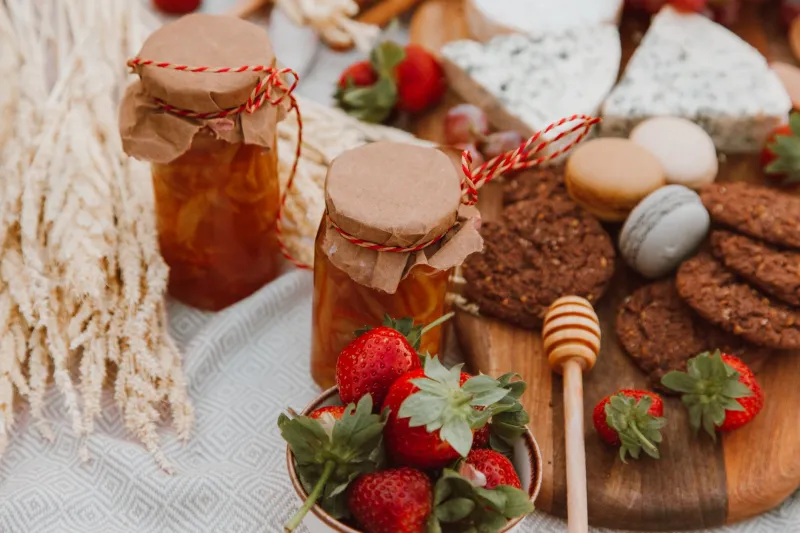
A fierce, turmeric-yellow piccalilli will make a cloth-bound Cheddar taste sharper, more industrial, more assertive than it did in the shop. A soft onion marmalade, slow-cooked until dark and jammy, will coax the same cheese towards caramel and toasted grain. Neither perception is wrong. Both are the chutney's doing. The cheese you believe you bought is, in truth, partly decided by what you serve alongside it.
Three Makers, Three Philosophies
To understand the stakes, we spent time with three British producers who treat the jar as seriously as any cheesemaker treats the vat.
Margaret Oduya, Bristol — the archivist. Oduya's small-batch quince and apple pastes are built from heritage orchard fruit she tracks down through the West Country's declining traditional groves. Her philosophy is historical: the accompaniment, she argues, should tell the cheese where it came from. 'A Somerset wedge wants a Somerset orchard next to it,' she says. 'Anything else is a conversation with a stranger.'
Tom Fairweather, Yorkshire — the contrarian. Fairweather's rhubarb and chilli relish has divided customers for a decade, and he would have it no other way. He believes a condiment should challenge, not comfort. 'If the pairing feels safe, I've failed,' he says. His bracingly acidic green tomato pickle, he insists, is the only honest partner for a rich, buttery Wensleydale: 'Fat needs friction.'
Ruth Callaghan, Kent — the minimalist. Callaghan makes exactly four things, each with a handful of ingredients and an unusually long shelf life. Her approach is deferential: the chutney's job is to disappear. 'A good preserve is a well-lit room,' she says. 'You notice the painting, not the lighting.' Her dark ale chutney, made with a Kentish bitter, has become a quiet cult favourite among cheese shops across the South East.
Three makers, three theories — and yet all three agree on one point: the pairing is not decoration. It is composition.
The Case for Taking Matching Seriously
Wine matching earned its seriousness over decades of trial, error and published wisdom. Cheese matching, by contrast, has been governed by habit: the pickle that was in the fridge, the chutney that came with the hamper. There is no reason this should remain the case.
The mechanics are the same as any pairing discipline. Fat meets acid. Sweet meets salt. Texture meets texture. A crystalline aged Gouda-style cheese and a coarse, vinegary relish argue productively; the same cheese with a smooth, sugary onion jam simply sits there, dulled. Think of the condiment as an editor of the cheese's character — it can sharpen the prose or bury the lede.
A Working Guide: Six Cheeses, Six Jars
For those persuaded, here is a practical starting point — six British cheeses matched to condiments worth making at home.
1. Montgomery's Cheddar with spiced apple and cider chutney. The orchard echoes the pasture; the acidity cuts through the cheese's deep, beefy savoury weight. Add a pinch of mustard seed to the chutney for edge.
2. Stichelton with quince paste. The metallic edge of a blue is tamed by quince's perfumed sweetness — an old Spanish principle that works beautifully with an English raw-milk blue.
3. Wensleydale with green tomato pickle. Fairweather's friction principle in action. The cheese's clean, lemony crumbliness meets sharp fruit and vinegar, and both parties emerge livelier.
4. Baron Bigod with dark ale chutney. A rich, spoonable Brie-style cheese wants something malty and slow-cooked. The bitterness of the ale keeps the pairing from tipping into cloying.
5. Lincolnshire Poacher with piccalilli. A bold match — the mustard heat and crunchy cauliflower stand up to the cheese's nutty, Swiss-adjacent depth. Serve the piccalilli cold and the cheese at room temperature, never the reverse.
6. Berkswell with shallot marmalade. The cheese's sweet, sheep's-milk caramel finds a mirror in slow-burnt shallots finished with a splash of sherry vinegar to stop the whole thing becoming dessert.
The Rack Deserves Better
There is a reason delicatessens place the accompaniment shelf at eye level now, and it is not merchandising cynicism. It is recognition. The jar is no longer the thing you grab on the way to the till; it is half the pleasure of the board. Choose it with the attention you give the wedge, and the cheese you thought you knew will introduce itself all over again.
And if a guest asks which came first — the cheese or the chutney — you may, with a clear conscience, decline to answer. Diplomacy, after all, is about knowing which silences to keep.